- B-10,Housing Board Colony, Kankarbagh - Patna
- Mon - Sat: 9:00 am - 8:00 pm | Sun : 9:00 am - 4:00 pm

WHY BIHAR ? (A STATE LIVING IN DARKNESS)
Eye Health Scenario in Bihar & Sri Sai Eye Hospital’s Contribution
(Sri Sai Eye Hospital – Best Eye Hospital in Patna, Bihar for Cataract & Vision Care)
Bihar is one of the most significant states of India, historically renowned as a centre of learning and culture. Despite its rich heritage, the pace of development in Bihar, especially in the healthcare and eye care sector, has been slow. The poorest and most underprivileged communities continue to suffer the most from limited access to quality eye treatment in Bihar. Comparative analyses by the Registrar General of India (RGI), NITI Aayog, and the Reserve Bank of India highlight these persistent challenges.
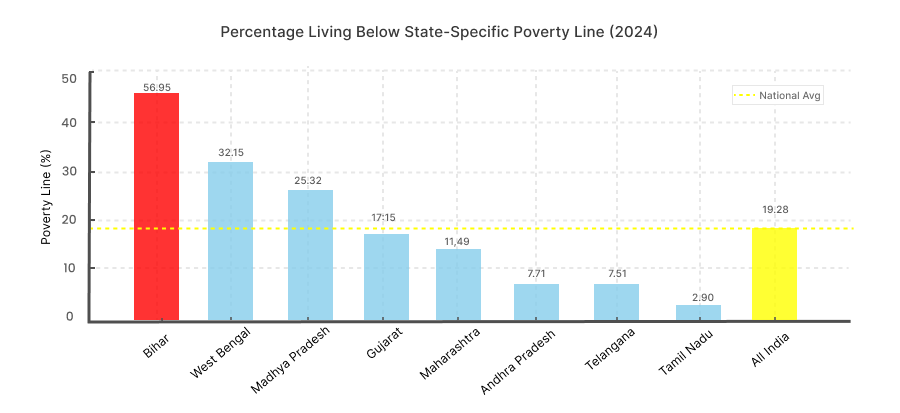
*Registrar General of India (RGI/MoHFW) hosted by NITI Aayog's Reserve Bank of India's 'Handbook of Statistics on Indian Economy and Wikipedia report
Owing to Bihar’s rapidly growing population and the high proportion of residents living below the poverty line, many government eye care initiatives struggle to sustain impact. Recent national surveys indicate that blindness prevalence among people aged 50 and above (2.2%) in Bihar is higher than the all-India rate (1.99%). Untreated cataract remains the leading cause of vision loss, accounting for nearly 73% of blindness cases in rural Bihar. With over 130 million people (as of 2024), the state faces three major barriers:
- 1. High poverty rate (56.95% of residents)
- 2. Low awareness of eye health and preventive care
- 3. Geographic and infrastructure gaps limiting access to eye hospitals and cataract surgery facilities
Sri Sai Eye Hospital’s Vision 2030 Approach
To overcome these challenges, solutions must move beyond short-term eye camps. Academic studies under the National Programme for Control of Blindness & Visual Impairment (NPCB & VI) emphasize integrated eye care models—linking primary screening, trained community workers, and referral systems to secondary and tertiary eye hospitals.
In alignment with IAPB’s Vision 2030: The Right to Sight, Sri Sai Eye Hospital (SSEH), Patna, one of the top eye hospitals in Bihar, has created a sustainable eye-care network through:
- 1. 15 Vision Centres and Tele-Ophthalmology Units across Patna, Ara, Fatuha, Bakhtiyarpur, Mokama, Barh, and other districts
- 2. Door-to-door eye screening and free eye check-up camps in underserved rural areas
- 3. Deployment of “Netra-Mitra” community outreach workers for patient identification and follow-up care
This multi-pronged eye care strategy in Bihar aligns with global research proving that community-based ophthalmic models increase cataract surgical uptake by 30–50% and significantly reduce post-operative default rates.
Cataract Surgical Rate in Bihar vs. National Average
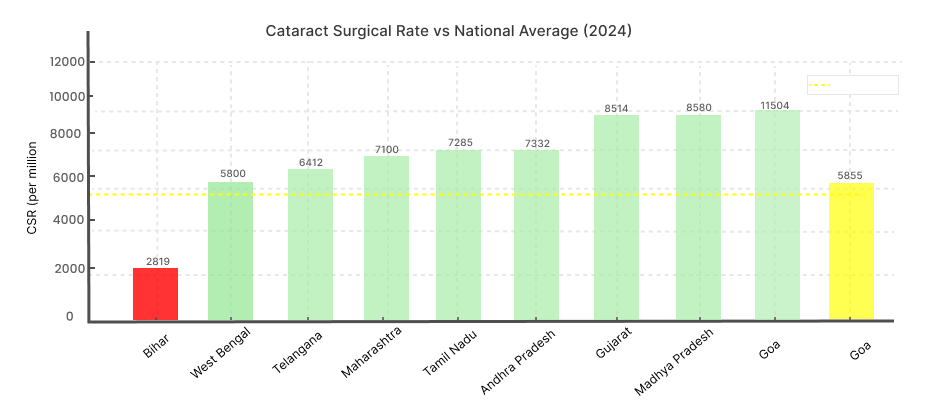
Updated 2024 Cataract Surgical Rate (CSR) data from NPCB & VI reveal that while the national average has risen to 5,855 surgeries per million population, surpassing the WHO benchmark, Bihar’s CSR lags at 2,819 per million.
This gap highlights both supply-side constraints (limited surgical capacity) and demand-side challenges, including high out-of-pocket expenses and lack of awareness. Research on cataract treatment programs in India identifies two key success factors:
- 1. Subsidized intraocular lens (IOL) provision
- 2. Active community mobilisation and awareness programs
Studies show that combining free cataract surgery vouchers with local “vision ambassador” programs can raise CSR by up to 40% within a year.
Sri Sai Eye Hospital’s Commitment to Eye Health in Bihar
Sri Sai Eye Hospital, Patna continues to uphold its commitment to excellence and equitable eye care for all, regardless of socio-economic status. The hospital’s Tele-Ophthalmology Centres, Vision Centres, and “Netra-Mitra” outreach programs have become models for affordable eye treatment in Bihar, improving cataract outcomes and expanding access to remote areas.
SSEH also collaborates with national and international NGOs, as well as corporate CSR initiatives, to strengthen community eye health programs and awareness about blindness prevention in Bihar.
It is clear that Bihar’s eye health sector has considerable ground to cover—but Sri Sai Eye Hospital remains steadfast in doing its part to restore vision, reduce blindness, and deliver quality eye care across Bihar.